
Imagine standing on a ladder in your Elmhurst home, staring at a cluster of copper and colored wires while wondering if you actually flipped the right breaker. It’s a common moment of doubt that turns a simple home upgrade into a stressful afternoon. We understand that the excitement of a new, modern light fixture often fades the moment you realize your old mounting box might not support the weight or the 2026 NEC updates regarding AFCI protection feel like a foreign language. You want a home that shines with updated style, but you shouldn’t have to risk a flicker or a fire to get it.
This guide will help you master the essentials of light fixture replacement by providing a comprehensive safety and installation checklist. We believe that 90% of a successful project happens before you even pick up a screwdriver. You’ll learn how to navigate mounting hardware, identify safe wiring practices, and gain the confidence to know when a task is a perfect DIY project or when it’s time to call our team at BrightWise. We’re here to ensure your home remains a safe, bright sanctuary for your family.
Key Takeaways
- Perform a foolproof safety audit by identifying the correct circuit and using a voltage tester to verify the power is completely off.
- Ensure your home’s structural integrity by matching the weight of your new fixture to the load-bearing capacity of your existing junction box.
- Master a stress-free light fixture replacement by documenting your original wiring with photos to ensure a perfect, flicker-free connection.
- Recognize the critical warning signs, such as outdated aluminum or knob-and-tube wiring, that indicate when it is time to call for professional assistance.
Pre-Installation Safety Audit: The “Power-Off” Checklist
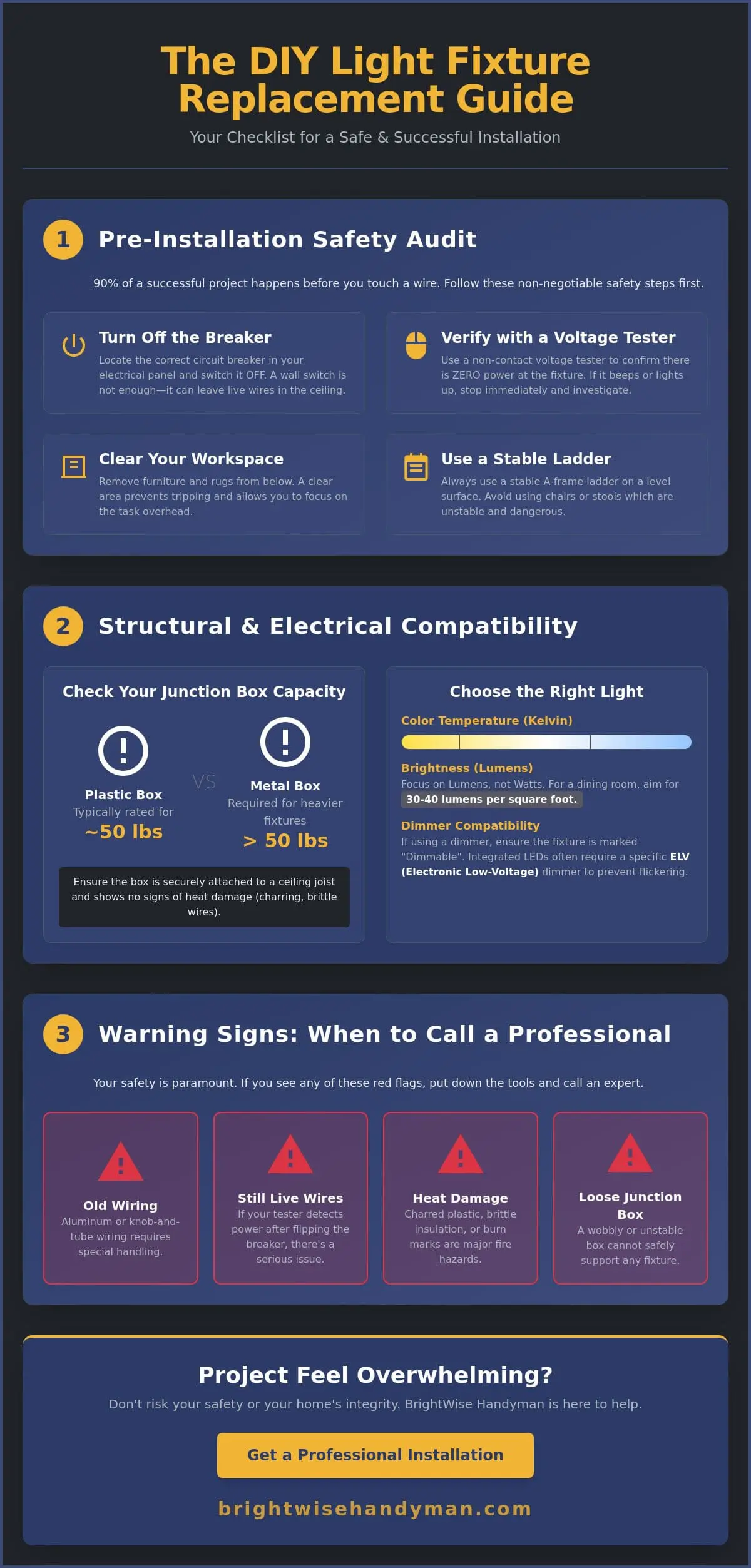
Safety is the foundation of every successful home project. We believe that a proper light fixture replacement begins long before you choose a new design. It starts at your electrical panel. You should never rely on a wall switch to cut the power. Switches only break the hot lead, which can leave live current sitting in the ceiling box. We recommend locating the specific circuit breaker for the room and switching it to the off position. Once you find it, label it clearly with a piece of tape. This simple step protects you and ensures anyone else in the house knows not to flip the power back on while you’re on the ladder.
Before you begin, prepare your physical workspace. Clear away furniture, rugs, or decorative items directly beneath the fixture. We always use a stable A-frame ladder placed on a level surface. Avoid using chairs or stools, as these lead to balance issues when you’re reaching overhead. A clean, open area allows you to focus entirely on the task at hand without worrying about tripping or falling.
Testing Your Circuit for Total Peace of Mind
A non-contact voltage tester is the most important tool in your kit. It’s a small, pen-shaped device that glows or chirps when it detects an electrical field. After you’ve turned off the breaker, climb your ladder and hold the tester near the fixture’s canopy and the wires inside. If the tool stays silent, the circuit is dead. If it lights up, power is still flowing. This happens more often than you’d think, especially in older homes where circuits might be shared or mislabeled. Having a foundational understanding electrical wiring helps you realize that residential systems are complex networks. If you find “hot” wires even after the breaker is off, it’s a sign of a deeper electrical issue that requires professional attention.
Assessing the Ceiling Box Capacity
Once you’ve removed the old fixture, take a close look at the junction box. You’ll likely find either a plastic or metal box. Plastic boxes are lightweight and common, but they often have lower weight ratings, typically around 50 pounds. Metal boxes are generally more robust and are required for heavier installations. Look for the weight rating stamped inside the box. If you’re planning to install a heavy chandelier or a ceiling fan, a standard plastic box won’t cut it. You’ll need a box that is braced directly to a ceiling joist.
Check the physical condition of the box and the wires. Look for signs of heat damage, such as charred plastic or brittle, cracked wire insulation. These are red flags for fire hazards. Give the box a firm tug to ensure it isn’t loose. If the mounting screws are stripped or the box wobbles, your new light fixture replacement will never sit flush or stay secure. We prioritize these small details to ensure your new lighting stays safe and steady for years to come.
Choosing Your New Fixture: The Compatibility Checklist
Selecting a new piece for your home is an exciting way to refresh your space. However, a successful light fixture replacement requires checking technical specs before you fall in love with a design. We recommend starting with the weight. If your new chandelier weighs over 50 pounds, a standard plastic junction box won’t hold it. You’ll need a heavy-duty metal box or a fan-rated brace. Before you head to the store, reviewing DIY Electrical Safety tips ensures you’re looking for the right safety certifications on the packaging. We also suggest checking the mounting bracket included in the box. A universal crossbar fits most standard boxes, but some modern designs use proprietary brackets that might require extra adjustments to your existing hardware.
Color temperature, measured in Kelvin (K), dictates the mood of your room. We suggest 2700K to 3000K for a warm, cozy living room feel. For kitchens or home offices, 4000K to 5000K provides a crisp, daylight effect that helps with focus. If you have a dimmer switch, verify that your new fixture is specifically labeled “dimmable.” Integrated LED fixtures are popular, but they often require specific electronic low-voltage (ELV) dimmers to prevent flickering or buzzing. We always verify these details to ensure your home stewardship leads to lasting, beautiful results.
Lumens vs. Watts: Lighting Your Room Correctly
Lumens measure brightness, while watts measure energy use. In the past, we relied on wattage to guess brightness. Now, we look at lumens. For a dining room, aim for 30 to 40 lumens per square foot. Integrated LED fixtures, which often cost between $100 and $150 in 2026, provide a higher Color Rendering Index (CRI). A CRI of 90 or above is ideal for bathrooms and kitchens. It ensures colors look natural and vibrant under the light. This level of care transforms a simple utility into a specific aesthetic improvement for your property.
Mounting Types and Ceiling Heights
Many homes in Elmhurst feature standard eight-foot ceilings. In these spaces, flush mounts or semi-flush mounts are the best choice. They provide plenty of clearance for tall guests and cabinet doors. For dining tables, the bottom of the fixture should hang 30 to 36 inches above the tabletop. If you’re tackling a high-foyer installation or a complex mounting project, our team can help with a professional ceiling fan installation or heavy fixture mount to ensure everything is perfectly level and secure. We treat your property with the same care as our own, ensuring every door and cabinet has the clearance it needs to swing freely.
The Essential Tool Kit for Light Fixture Replacement
Having the right gear transforms a potentially stressful chore into a smooth, professional project. We’ve seen many DIY attempts stall because a homeowner had to climb down the ladder five times to find a different screwdriver or a roll of tape. A successful light fixture replacement relies on a pre-staged kit that prioritizes safety and precision. Before you ever touch a wire, gather these essentials to ensure you can work efficiently without interruption.
- Non-contact voltage tester: As we mentioned in the safety audit, this is your most vital tool. It provides an immediate, audible confirmation that the power is truly off.
- Wire strippers and crimpers: These allow you to remove insulation without damaging the copper strands. Clean, properly sized exposed wire is the key to a flicker-free connection.
- Insulated screwdriver set: We recommend using Phillips and flathead drivers with rubberized, insulated handles. This adds a secondary layer of protection against unexpected current.
- High-quality connectors: Stock up on various sizes of wire nuts or modern lever-style connectors to handle different wire gauges.
- Headlamp and electrical tape: A headlamp is far superior to a flashlight because it keeps both of your hands free for wiring. Electrical tape helps secure wire nuts and provides extra insulation.
Professional Supplies vs. Budget Basics
We believe that using professional-grade supplies makes the job safer for everyone. While traditional twist-on wire nuts are common, we prefer Wago lever-style connectors. These allow you to simply insert the wire and snap a lever shut. They provide a more secure, vibration-resistant bond and offer a clear window to see if the wire is fully seated. We also suggest keeping a magnetic parts tray on your ladder shelf. It prevents those tiny, specialized mounting screws from disappearing into your carpet or floor vents. If your new fixture has a larger canopy than the old one, a small drywall saw can help you make minor adjustments to the ceiling opening for a perfect fit.
Ladder Safety and Spotter Protocols
Choosing the right ladder is just as important as choosing the right screwdriver. For standard eight-foot ceilings in Elmhurst, a six-foot A-frame ladder is ideal. It allows you to work comfortably without reaching over your head too far. If you’re dealing with vaulted foyers, you’ll need a taller, stable platform. We follow the “Three-Point Contact” rule religiously: always keep two feet and one hand, or two hands and one foot, firmly on the ladder. Never stand on the top two rungs, as this significantly shifts your center of gravity and leads to tips. If the fixture is bulky, ask a family member to act as a spotter to hand you tools and help steady the ladder while you work.
Step-by-Step Installation: The “Swap-Out” Checklist
We’ve reached the most rewarding part of the project. Before you unscrew the old wire nuts, grab your phone. Taking a quick photo of the original wiring configuration is a lifesaver. It shows you exactly how the previous installer handled the connections, which is especially helpful if your home has non-standard wire colors. Once you’ve documented the setup, disconnect the old fixture. We recommend having a partner hold the weight of the old unit while you unscrew the mounting hardware to prevent the wires from straining or snapping.
Next, install the new mounting bracket to the junction box. Ensure it sits flush against the ceiling and is tightened securely. A loose bracket leads to a wobbly fixture and can cause the canopy to gap over time. When you’re ready to wire, always connect the ground wire first. This is usually a green or bare copper wire. Securing the ground first provides an immediate safety path for electricity. Then, join the neutral (white) wires together and the hot (black) wires together. Twist the wire nuts until they’re tight, and give each wire a gentle tug to ensure it’s locked in place. If you’re feeling overwhelmed by a bundle of extra wires, reach out to us for a professional light fixture replacement to ensure your home stays safe and bright.
Handling Complex Wiring Scenarios
Suburban Chicago homes, particularly those in established neighborhoods like Elmhurst, often feature “switched leg” wiring. You might find two white wires or an extra red wire in the ceiling box. Usually, a red wire indicates that the fixture is controlled by two different switches or that it was previously wired for a ceiling fan. If your new fixture has multiple arms or sockets, they will likely be pre-wired into a single black and white lead. We always double-check these connections to prevent a “dead” socket after the installation is complete. If the wiring doesn’t match your photo or our guide, it’s a sign to pause and seek expert advice.
The Final Testing and Finishing Touches
Once the wires are connected, tuck them neatly into the junction box. Avoid pinching the insulation when you press the canopy against the ceiling. Secure the decorative nuts or screws, then head back to the breaker panel. After flipping the power back on, test the wall switch. If you notice flickering or a humming sound, it often indicates a compatibility issue between your LED bulbs and the dimmer switch. Finally, clean the fixture with a microfiber cloth and adjust any shades or pendants so they’re perfectly level. We take pride in these finishing touches, as they turn a simple repair into a specific aesthetic improvement for your home.
When to Call a Professional Handyman in Elmhurst
We encourage homeowners to take pride in their home stewardship, but some situations demand the authority of a seasoned expert. If you open your ceiling box and find frayed insulation or silver-colored aluminum wiring, please stop immediately. Many older properties in our community still contain knob-and-tube systems. These require specialized handling to prevent fire hazards. Some tasks go beyond a simple swap. If your new light fixture replacement involves a grand chandelier weighing over 50 pounds, the structural requirements change. You likely need a new brace installed to support that weight safely.
Working at heights is another factor that requires caution. If the mounting location requires a 12-foot ladder or higher, the risk of a fall increases significantly. We also recommend calling us if you want to add a new light where one didn’t exist before. This involves running new circuits through your walls and ceiling joists, which is a task best left to those with professional training. We prioritize your peace of mind and the long-term safety of your property.
The Risks of Improper DIY Installation
Improper installation carries hidden dangers that can surface long after the project is finished. Loose wire connections are a leading cause of electrical arcing. This occurs when electricity jumps across a small gap, creating intense heat that can ignite nearby materials. Improper grounding is another common mistake. If the ground wire isn’t secured properly, you might experience a sharp electric shock just by touching the metal wall switch plate. Beyond the electrical dangers, there is the physical risk to your home. A poorly mounted fixture can pull away from the ceiling. This leads to expensive drywall repair or a shattered fixture.
The BrightWise Advantage: Local, Reliable, and Clean
Choosing a partner for your home stewardship means looking for meticulous professionals who value order. We treat your property with the same care as our own. Our “Leave No Trace” policy ensures we never leave wire clippings, drywall dust, or packaging behind. We prioritize a clean workspace and a perfect, flicker-free finish. Our team also brings expertise in modern technical installations, including smart home integrated lighting and complex dimmer setups. We ensure your new lighting is fully compatible with your existing smart ecosystem. Book your Elmhurst light fixture replacement with BrightWise today! We are your dependable neighbors, ready to add lasting value and beauty to your home.
Brighten Your Home with Confidence
Mastering a light fixture replacement is about more than just aesthetics; it’s about the safety and integrity of your home environment. By following a rigorous “power-off” checklist and ensuring your junction box is rated for the weight of your new chandelier, you prevent the most common DIY disasters. Whether you’re upgrading to modern integrated LEDs or documenting your wiring with photos for a smooth swap, your focus on preparation ensures a flicker-free result that adds lasting value to your property.
We’ve been serving Elmhurst and the Western Suburbs since 2022 as a fully insured, local owner-operated business. We specialize in both traditional manual trades and modern smart home lighting setups, ensuring your home remains a safe and beautiful sanctuary. If you’re facing high ceilings, heavy fixtures, or complex wiring that feels a bit too daunting, we’re here to help you cross the finish line with ease and professionalism. Get a Free Estimate for Your Lighting Project today. We look forward to partnering with you on your next home improvement project and helping your vision shine bright.
Frequently Asked Questions
Do I need a permit for light fixture replacement in Elmhurst, IL?
You typically don’t need a permit for a straightforward swap where you are replacing an existing fixture with a similar model. However, the City of Elmhurst requires a permit if you’re running new electrical lines or adding a completely new circuit to your panel. It’s a good practice to contact the local building department if your project involves more than just a simple hardware update.
Why does my new LED light fixture flicker when I turn it on?
Flickering is most often caused by a compatibility issue between your new LED and an older dimmer switch. Standard dimmers weren’t designed for the low-voltage requirements of modern LEDs, which leads to a pulse or “strobe” effect. If you aren’t using a dimmer, the flickering might signal a loose neutral wire connection. You should double-check your wire nuts to ensure every connection is tight and secure.
Can I replace a light fixture myself if I have no electrical experience?
You can perform a basic light fixture replacement yourself if you follow a rigorous safety checklist and use the right tools. However, working with electricity carries inherent risks of shock or fire if the connections aren’t handled with precision. If you feel any confusion over wire colors or mounting hardware, we recommend calling a professional to ensure your home remains a safe sanctuary for your family.
What is the difference between the black, white, and green wires?
These colors identify the specific role each wire plays in your home’s electrical circuit. The black wire is the “hot” lead that carries the current from the panel to your fixture. The white wire is the “neutral” that completes the circuit by carrying the current back. The green or bare copper wire is the ground, which provides a safe path for electricity to travel if there is a fault in the system.
How much does a handyman charge to replace a light fixture near me?
Professional rates for lighting projects vary depending on the height of your ceiling and the complexity of the fixture’s assembly. Most local experts charge a minimum service fee to cover their travel and initial setup time. If your project requires a new support brace for a heavy unit or involves high foyers, the total will reflect the extra time and specialized equipment needed for a safe installation.
Can I install a heavy chandelier in a standard plastic ceiling box?
You should never mount a fixture weighing more than 50 pounds to a standard plastic junction box. These boxes are not designed to support heavy loads and can eventually crack or pull away from the ceiling. For heavy chandeliers, we always install a metal box or a specialized brace that anchors directly to the ceiling joists. This ensures your fixture stays securely in place for years to come.
What should I do if my ceiling wires are both the same color?
If your wires aren’t color-coded, you must use a non-contact voltage tester to identify which lead is “hot” before making any connections. This situation is common in older homes where the original insulation has faded or been painted over. Once you identify the hot wire, mark it with a small piece of black electrical tape. If you can’t clearly distinguish the wires, it is safest to stop and seek expert help.
How long does it typically take to swap out a standard flush-mount light?
A standard swap typically takes between 30 and 60 minutes when you have all your tools ready and the area cleared. This timeline includes the time required to perform a safety audit, remove the old hardware, and secure the new canopy. If you encounter brittle wiring or a junction box that needs minor adjustments, the process may take a bit longer to ensure everything is perfectly aligned and safe.
