
Imagine you’ve just brought home a beautiful new modular cabinet, ready to finally organize your living room. You’re excited to see the finished result, but as soon as you open the box, that enthusiasm turns into a sinking feeling. You’re staring at a sea of identical screws and a manual that looks more like a riddle than a guide. With the DIY furniture market reaching over $229 billion in 2026, learning how to avoid furniture assembly frustration is the key to protecting your time and your sanity.
We understand that a simple project can quickly become a source of stress. It’s frustrating to deal with cryptic instructions, missing hardware, or the fear of damaging an expensive new purchase. You deserve to enjoy your home without the physical strain and lost time. We believe in being a partner in your home stewardship, and that starts with making sure your living space is functional and organized. In this guide, we’ll share our systematic steps and professional secrets to help you transform a confusing pile of parts into a perfectly assembled, sturdy piece of furniture. We’ll cover everything from organizing your workspace to the essential tools that make the job seamless, ensuring your weekend stays stress-free.
Key Takeaways
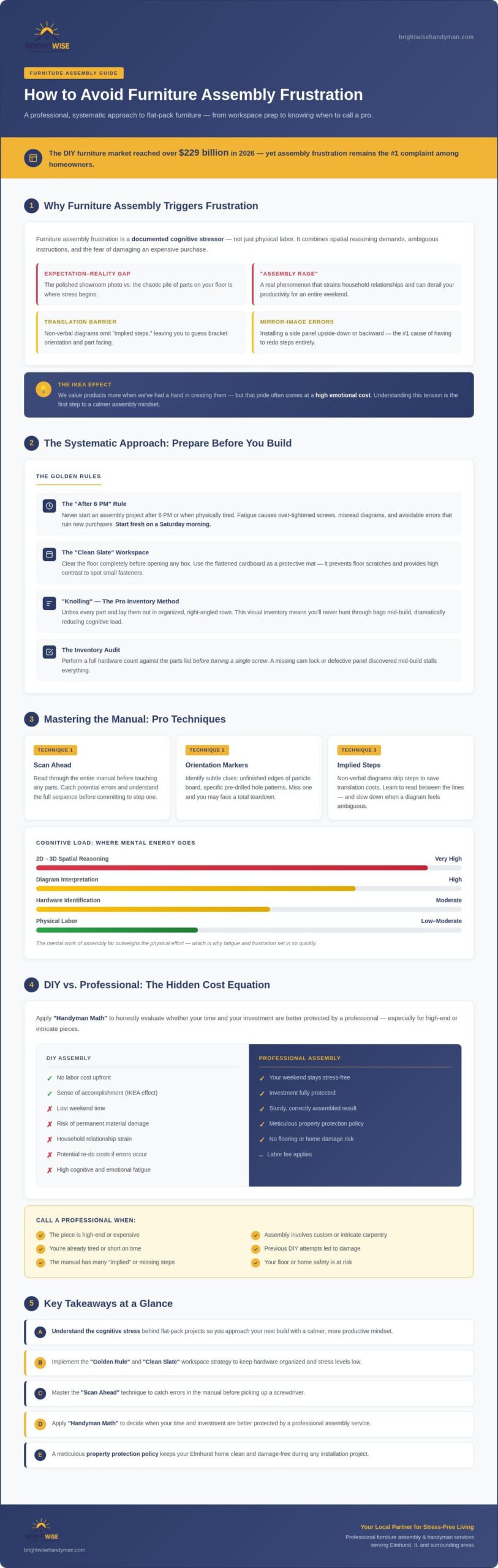
- Understand the cognitive stress behind flat-pack projects so you can approach your next build with a calmer, more productive mindset.
- Implement the “Golden Rule” and “Clean Slate” workspace strategies to effectively avoid furniture assembly frustration and keep your hardware organized.
- Master the “Scan Ahead” technique to catch potential errors in the manual before you even pick up a screwdriver.
- Learn how to apply “Handyman Math” to decide when your time and the safety of your investment are better served by a professional.
- See how a meticulous property protection policy keeps your Elmhurst home clean and damage-free during any installation project.
The Psychological Toll: Why Furniture Assembly Triggers Frustration
Unboxing a new piece of furniture should feel like a victory for your home. You’ve spent hours browsing, you’ve measured your space, and you’ve finally made the purchase. However, for many homeowners, that excitement quickly evaporates the moment the box is opened. Furniture assembly frustration is a documented cognitive stressor caused by intense spatial reasoning demands. It isn’t just about the physical labor; it’s about the mental exhaustion of solving a complex puzzle under pressure. We believe that understanding this psychological toll is the first step toward a more peaceful home environment.
There is a massive gap between the sleek, finished photos you see on websites like Wayfair or IKEA and the chaotic pile of parts on your floor. This “Expectation-Reality Gap” is where the stress begins. While The IKEA effect suggests we value products more when we’ve had a hand in creating them, that pride often comes at a high emotional cost. “Assembly rage” is a real phenomenon that can strain household relationships and derail your productivity for an entire weekend. We view these projects as modern home stewardship tasks. They require patience, precision, and a professional mindset to get right.
The Problem with “Universal” Instruction Manuals
Most manufacturers use non-verbal diagrams to save on translation costs. This creates a literal language barrier between you and your new furniture. These guides often rely on “implied steps” that aren’t explicitly drawn, leaving you to guess how a specific bracket should face. To avoid furniture assembly frustration, you must learn to identify “Orientation Markers.” These are subtle clues, like an unfinished edge of particle board or a specific pattern of pre-drilled holes, that the manual frequently fails to highlight. Missing just one of these markers can lead to a total teardown later in the process.
Cognitive Load and Spatial Reasoning Challenges
Translating a 2D drawing into a 3D object is a heavy lift for the human brain. Your mind has to rotate images and predict how pieces fit together before you ever pick up a screwdriver. “Mirror Image” errors are the most common cause of re-doing steps; it’s incredibly easy to install a side panel upside down or backward because it looks correct on paper. Furniture assembly frustration is a recognized stressor for modern homeowners. When you’re dealing with high-end items or intricate Custom Carpentry, the stakes are even higher. One wrong move can permanently damage the material, turning your investment into a costly mistake.
The Systematic Approach: Preparing Your Space and Mindset
Success in home improvement rarely happens by accident. It’s the result of a disciplined process. To avoid furniture assembly frustration, we recommend establishing a “Golden Rule” for your home: never start an assembly project after 6 PM or when you’re already physically tired. Fatigue is the enemy of precision. When you’re exhausted, you’re more likely to over-tighten a screw or misread a diagram, leading to avoidable errors that can ruin your new purchase. By starting fresh on a Saturday morning, you give yourself the mental runway needed to handle complex instructions with a clear head.
Your environment dictates your efficiency. We always suggest a “Clean Slate” workspace. Before you open a single box, clear the floor of toys, rugs, or clutter. Use the flattened cardboard box from the furniture itself as a protective mat for your flooring. This simple step prevents scratches on your hardwood or snags in your carpet while providing a high-contrast surface that makes it easier to see small fasteners. Professionals use a method called “knolling,” which involves unboxing every piece and laying them out in organized, right-angled rows. This visual inventory ensures you don’t have to hunt through plastic bags mid-build. Experts who study how to manage stress during DIY projects agree that this level of organization significantly lowers the cognitive load and prevents the feeling of being overwhelmed.
The Inventory Audit: Catching Errors Early
Nothing stalls progress like a missing cam lock or a defective side panel. Perform a full hardware count against the parts list before you turn a single screw. If a piece of hardware is missing, stop immediately. Don’t try to “make it work” with spare screws from your junk drawer, as this often leads to structural instability. Inspect the particle board for cracks or misdrilled holes. Catching these issues while the item is still in pieces makes the return or replacement process much simpler. If the logistics of sorting hundreds of parts feels daunting, our professional furniture assembly service can step in to manage the entire workflow from unboxing to the final polish.
Creating a Controlled Assembly Environment
Lighting is a tool just like a screwdriver. Shadows are your enemy when you’re trying to align internal dowels or find a tiny pre-drilled pilot hole. Ensure the room is brightly lit, or use a portable work light to illuminate the interior of cabinets. For smaller components like drawers, work at a waist-high table to avoid unnecessary back strain. Finally, establish a “No-Distraction Zone.” Turn off the television and keep pets or young children out of the work area. This focus allows you to spot “Orientation Markers” and avoid the mirror-image errors we discussed in the previous section.
Mastering the Manual: Deciphering Diagrams and Hardware
The secret to a smooth build isn’t just having the right tools; it’s having the right strategy for the paperwork. We recommend the “Scan Ahead” technique. Before you touch a single screw, read the entire manual from cover to cover. This helps you identify the “Critical Path” of the project. These are the specific steps where an error, like installing a structural support backward, forces a total teardown of the piece. By seeing the finish line before you start, you can avoid furniture assembly frustration and spot potential pitfalls before they happen. Understanding the manual also helps manage the emotional side of the build. While The IKEA Effect suggests we feel more attached to things we build ourselves, that pride only exists if the item actually functions when you’re finished.
We also suggest a “Sub-Assembly” strategy for larger items like wardrobes or entertainment centers. Instead of trying to build the entire frame at once, focus on building drawers, doors, or internal shelving as separate, manageable tasks. This approach breaks the project into smaller wins and prevents your workspace from becoming cluttered with half-finished components. During these steps, pay close attention to the edges of the panels. Diagrams often use subtle shading to indicate “Finished” versus “Unfinished” edges. Aligning the unfinished, raw particle board edges toward the back or bottom is the most reliable way to ensure your furniture looks professional and is oriented correctly.
Hardware 101: Cam Locks, Dowels, and Euro-Hinges
Understanding the anatomy of your hardware is vital for structural integrity. The cam lock is the most common fastener in flat-pack furniture, yet it’s often the most misunderstood. These only require a half-turn to lock the pieces together. Over-tightening them doesn’t make the piece sturdier; it actually leads to structural failure by stripping the wood or snapping the metal. For wood dowels, we often suggest adding a small drop of wood glue to the hole, even if the manual doesn’t mention it. This creates a permanent bond that prevents the wobbling often associated with DIY furniture. Finally, if your cabinet doors look crooked, don’t panic. Euro-hinges feature a three-way screw system that allows you to adjust the door up, down, left, or right until the alignment is perfect.
Interpreting Cryptic Visual Cues
Instruction manuals are filled with visual shorthand that can be confusing. Symbols like “X2” simply mean you need to repeat the entire step for a matching part, while “L/R” indicates specific left and right orientations that are rarely interchangeable. You should also learn to distinguish between a “Pilot Hole,” which is a small guide for a screw, and a “Clearance Hole,” which is a larger opening designed for a bolt to pass through. Particle board is prone to splitting when fasteners are misaligned because the compressed fibers cannot handle the lateral pressure of a crooked screw. Taking a moment to double-check your alignment against the diagram’s holes will save you from a ruined panel and a lot of headaches.
The Hidden Costs of DIY: When to Call an Elmhurst Professional
We often approach home projects with the goal of saving money, but true “Handyman Math” requires looking at the total investment of your time and energy. If a complex wardrobe takes you eight hours to complete, you must weigh that against your own professional hourly rate. For many Elmhurst homeowners, the most effective way to avoid furniture assembly frustration is recognizing when a project exceeds their available bandwidth. Your weekend is a limited resource. Spending it surrounded by cardboard and cryptic diagrams often costs more in stress than the price of professional assistance.
There is also the very real risk of physical damage to your property. If you have invested in Custom Carpentry or high-end modular systems, one slip of a manual screwdriver can cause permanent, visible scarring. We also see a significant “Tool Gap” in most households. While a basic toolkit is fine for hanging a picture, modern flat-pack fasteners often require specific torque-limited drivers to prevent stripping. Beyond aesthetics, safety is a non-negotiable factor. Improperly anchored heavy furniture, such as tall bookshelves or TV stands, poses a severe tipping risk that professional installers are trained to mitigate using load-bearing wall anchors.
Evaluating the Complexity Scale
We categorize assembly projects on a scale from one to five. A simple coffee table is a Level 1, manageable for most. However, Level 5 projects like Murphy beds or integrated PAX systems involve structural alignments where “two-person” steps are mandatory for safety. You should establish a personal “Frustration Threshold.” If you find yourself forcing a piece into place or re-reading the same step for twenty minutes, it’s time to stop. Forcing progress usually leads to broken dowels or split particle board, turning a minor delay into a permanent failure.
The Value of Peace of Mind and Warranty
Hiring a professional does more than just build the item. It preserves your manufacturer warranty, as many companies won’t cover structural damage caused by improper consumer assembly. We also provide a “White Glove” experience that includes the organization and disposal of massive amounts of cardboard and plastic. Local residents value their interior aesthetics, and a professional finish ensures every drawer slides smoothly and every door sits flush. If you’re ready to reclaim your weekend and ensure your new furniture is built to last, you can book our professional furniture assembly service today.
BrightWise Handyman: Your Local Partner for Stress-Free Living
We believe that your home should be a sanctuary, not a construction site. BrightWise Handyman stands as the Elmhurst authority on meticulous home repairs and assembly. We understand that the most reliable way to avoid furniture assembly frustration is to hand the project over to a team that treats your property with the same care as their own. We handle the “Final Mile” of your purchase, managing everything from the initial unboxing to the perfect placement and structural anchoring of your new items. This comprehensive approach ensures that your furniture isn’t just put together; it’s integrated perfectly into your living environment.
Our “Respect for Property” policy is a core commitment that sets us apart. We use shoe covers and dedicated work-zone protection mats to ensure your floors remain pristine throughout the process. We also understand local environmental factors that generic guides overlook. In the Western Suburbs, fluctuating seasonal humidity can affect how particle board panels fit together. We use professional techniques to account for these shifts, ensuring your cabinet doors don’t bind or sag over time. Additionally, we manage the massive amount of cardboard and plastic waste that comes with modern furniture, leaving you with a beautiful home instead of a pile of trash.
Many modern furniture pieces now include integrated technology or require precise placement near power sources. We specialize in Smart Home Installation Services, which allows us to wire your new desk or entertainment center for seamless connectivity as we build it. This dual expertise ensures that your home remains both functional and aesthetically pleasing without visible cord clutter.
Serving Elmhurst and the Western Suburbs
We are proud to have a strong local presence in Villa Park, Oak Brook, and Lombard. This proximity allows us to provide rapid, dependable service to our neighbors. We understand the specific spatial challenges of suburban layouts, from navigating narrow basement stairs in older homes to fitting large modular systems into modern open floorplans. The Elmhurst community’s preference for quality home stewardship and professional reliability drives our commitment to excellence in every task we undertake.
Beyond Assembly: A Complete Home Solution
We offer a complete home solution that goes far beyond simply turning screws. We can easily combine your assembly project with our TV Mounting Service in Elmhurst to create a fully realized media room in a single visit. We take pride in our efficiency and our commitment to leaving your home cleaner than we found it. The BrightWise guarantee is built on integrity, punctuality, and a quiet confidence that your project will be completed to the highest professional standard, providing you with long-term peace of mind.
Reclaim Your Weekend and Enjoy Your New Home
We’ve discussed how a “prep-first” mindset and technical mastery of hardware can help you avoid furniture assembly frustration. By organizing your workspace and scanning manuals for orientation markers, you protect your time and your investment. However, some projects demand the precision and specialized tools that only a professional can provide. We believe that your home improvements should add value to your life without the psychological toll of “assembly rage.”
Since 2022, we have served as the dependable neighbor for Elmhurst residents. We are experts in assembling everything from IKEA and Wayfair flat-packs to high-end custom pieces. Our 5-star local reputation is built on integrity, punctuality, and our promise to leave your home cleaner than we found it. We treat every project with a quiet confidence that ensures your furniture is sturdy, safe, and perfectly placed.
Skip the frustration and book your professional assembly service today!
You deserve an organized living space that reflects your personal style. We are ready to help you cross that final task off your list so you can finally relax in your beautiful home. Let’s make your next delivery a stress-free success.
Frequently Asked Questions
Why is furniture assembly so frustrating compared to other home tasks?
Furniture assembly is uniquely taxing because it requires intense spatial reasoning and the translation of 2D diagrams into 3D objects. Unlike painting or simple repairs, one small error early in the process can compromise the entire structure. This creates a high mental load that leads to fatigue and mistakes. We see many homeowners struggle with the “language barrier” of non-verbal instructions that prioritize manufacturer cost-saving over consumer clarity.
What tools do I actually need to avoid furniture assembly frustration?
You need a high-quality set of manual screwdrivers, a rubber mallet, and a spirit level to effectively avoid furniture assembly frustration. The tiny wrenches included in the box are often difficult to grip and can easily damage the hardware. A dedicated set of tools allows for better torque control and prevents the stripping of delicate particle board fibers. We also recommend using a headlamp to illuminate small, dark interior cabinet corners.
Is it worth hiring a handyman for a single piece of furniture in Elmhurst?
Hiring a professional is often the best choice to avoid furniture assembly frustration when dealing with large or intricate pieces. While it might seem like a small task, a single dresser can take an inexperienced person an entire afternoon to complete. Our team brings the right tools and years of expertise to ensure the piece is sturdy and safe. This allows you to reclaim your weekend for family and community activities in Elmhurst.
What should I do if a piece of furniture arrives with missing parts?
You should stop the assembly process immediately and contact the manufacturer for a replacement if you find missing hardware. Never attempt to use “similar” screws from your garage, as they won’t provide the correct tension or fit. Using the wrong fasteners can lead to structural failure or permanent damage to the wood panels. It’s better to wait a few days for the correct parts than to risk a collapsed bookshelf.
How long does it typically take a professional to assemble a large wardrobe?
A professional typically completes a large wardrobe assembly in two to four hours depending on the internal configuration. This same project often takes a homeowner eight hours or more when factoring in the learning curve of the instructions. We work efficiently because we recognize common hardware patterns and orientation markers instantly. This speed doesn’t sacrifice quality; it’s the result of repetitive mastery and the use of specialized, professional-grade tools.
Can a handyman help with anchoring furniture to the wall for child safety?
Yes, anchoring furniture to the wall is a vital part of our professional service to ensure child and pet safety. Heavy items like dressers and TV stands are prone to tipping if they aren’t secured to a wall stud. We use load-rated anchors that are appropriate for your specific wall type. This step provides essential peace of mind and is a standard safety requirement for any tall or top-heavy furniture in the home.
What is the best way to dispose of all the cardboard and packing materials in Elmhurst?
The City of Elmhurst offers robust recycling programs for cardboard, but you must break the boxes down completely for curbside pickup. Large amounts of styrofoam and plastic film often require a trip to a specialized recycling center to avoid landfill waste. When you hire our team, we handle the entire cleanup process for you. We remove all packing materials and leave your home spotless so you don’t have to deal with the waste.
How do I know if I have the right type of wall for anchoring heavy furniture?
You can identify your wall type by tapping the surface or using a stud finder to locate the underlying supports. Drywall is common in newer homes, while older Elmhurst properties may have lath and plaster or masonry. Each material requires a different type of anchor to hold weight safely. If you aren’t sure, a professional assessment is the safest way to prevent your heavy furniture from pulling away from the wall and causing injury.
