
A great ceiling fan installation isn’t actually about the motor; it’s about the structural integrity of your mounting point and the precision of the balance. Many homeowners in our community worry that a new fixture might rattle or, worse, strain the aging electrical systems found in some of our more historic neighborhoods. If you are considering a professional ceiling fan installation Elmhurst project, you likely want more than just a breeze. You want a whisper-quiet addition to your home that enhances your comfort without compromising safety.
We understand the frustration of a wobbly fan that keeps you up at night or the confusion of trying to match a modern smart fan with older wiring. We believe your home deserves the same care and meticulous attention to detail that we would give our own properties. In this guide, we’ll walk you through selecting the perfect blade span for your room size and the importance of using ENERGY STAR certified models to lower your utility bills. You will also learn about the current $127 electrical permit fee required by the City of Elmhurst and how to ensure your new smart home features integrate seamlessly for a truly modern living space.
Key Takeaways
- Learn why upgrading to a heavy-duty, fan-rated box is a non-negotiable safety requirement for the older bungalows common in our community.
- Master the “7-Foot Rule” and blade span calculations to ensure your fan provides optimal airflow without becoming a safety hazard in low-ceiling rooms.
- Identify the specific safety risks, such as 10-foot ceilings and complex remote receivers, that signal when a ceiling fan installation Elmhurst project needs professional expertise.
- Follow our safety-first checklist to verify power disconnection and secure mounting brackets using professional-grade hardware for a wobble-free finish.
- Discover how to integrate modern fixtures with your smart home ecosystem to enable voice-controlled cooling and automated temperature scheduling.
Planning Your Ceiling Fan Installation in Elmhurst: Wiring & Safety
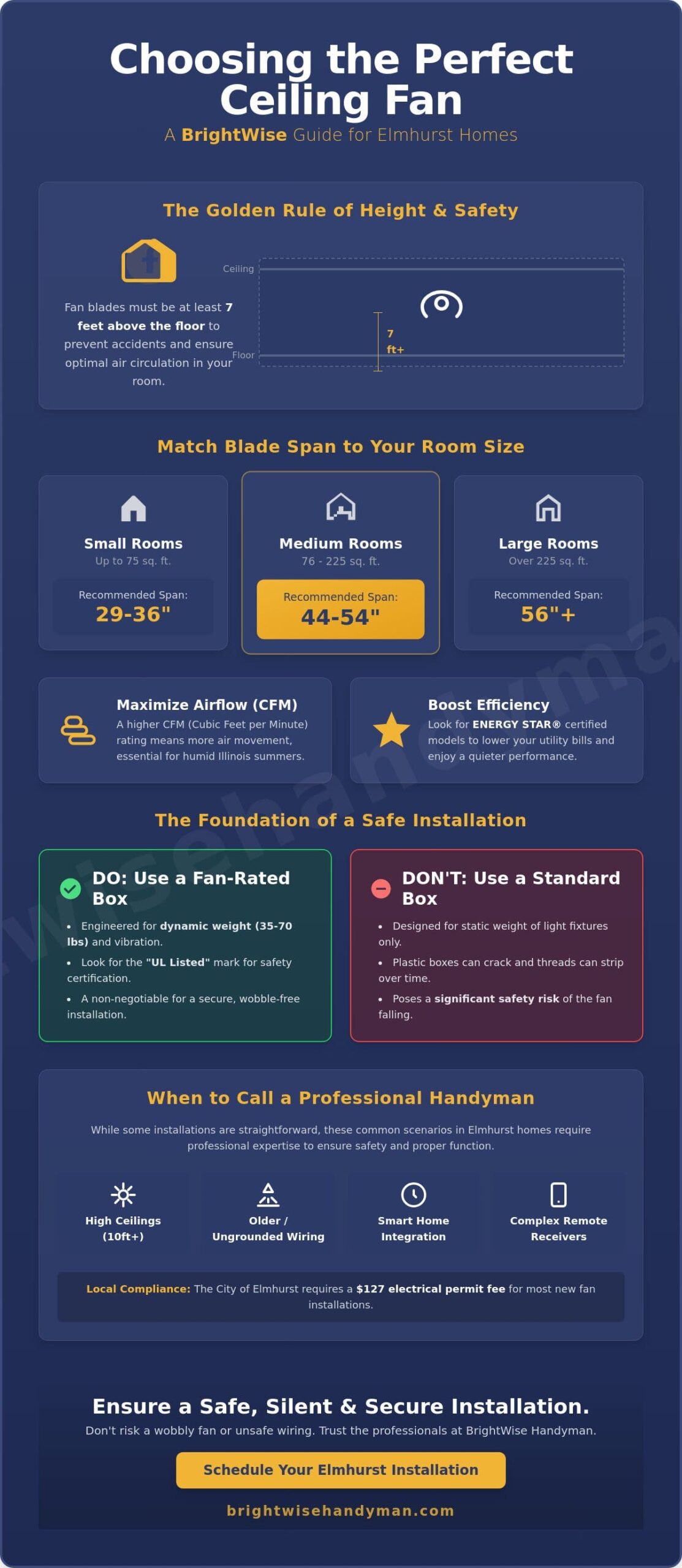
A successful project begins with a foundation that goes beyond simple aesthetics. Many of our local bungalows and historic properties in the community were built long before modern electrical codes accounted for heavy, motorized fixtures. A standard light fixture box is designed to hold a static weight, usually around 50 pounds; however, it isn’t built to handle the constant vibration and torque of a spinning motor. For a safe ceiling fan installation Elmhurst project, you must use a fan-rated box. These heavy-duty electrical boxes are specifically engineered to support 35 to 70 pounds of dynamic weight. You can identify them by the “UL Listed” mark and the specific screw size, usually #10-24, used to secure the fan bracket directly to the box.
The National Electrical Code (NEC) is very clear: any ceiling box intended to support a fan must be specifically marked for that purpose. We often see DIY attempts where a fan is mounted to a standard plastic “new work” box. This is a significant safety risk. Over time, the centrifugal force can strip the threads or crack the plastic, leading to a catastrophic failure. Understanding the history and types of ceiling fans helps you appreciate how much these designs have evolved, but the physics of weight and movement remains constant. We prioritize these structural details to ensure your home remains a safe sanctuary for your family.
Assessing Your Existing Electrical Setup
Safety begins with a solid foundation. In many older Illinois homes, the lack of a dedicated grounding wire is a common hurdle. We always check for this first because a grounded connection is your primary defense against electrical shorts. You also need to verify if your existing wall switch is compatible. If you’re moving from a simple light to a fan-and-light combo, your wiring might only support one function at a time unless you use a remote receiver. We never recommend mounting a fan to a plastic light box, as these materials lack the rigidity required for long-term stability. If you’re also planning to update other fixtures throughout your home, our light fixture replacement checklist can help you prepare for each project with the right safety steps and mounting hardware knowledge.
Essential Tools for a Proper Install
Proper tools make the difference between a professional result and a weekend headache. A non-contact voltage tester is your most important safety companion. It confirms the power is truly off before you touch a single wire. We also recommend using a torque wrench. It might seem like overkill, but properly tightened bolts prevent the “fan click” noise that develops when components loosen over time. Don’t forget your safety gear. Eye protection is vital for catching the plaster dust that inevitably falls from the ceiling, and a stable, A-frame ladder is essential for reaching heights safely during a ceiling fan installation Elmhurst project.
How to Choose the Perfect Fan for Your Space
Selecting the right fixture is about more than just matching your decor; it’s a calculation of volume and velocity. For your ceiling fan installation Elmhurst project, you need to match the blade span to your room’s square footage to ensure efficiency. Based on industry standards, rooms under 75 square feet benefit most from 29 to 36-inch blades. If you’re updating a master suite or a living area between 145 and 225 square feet, you should look for a span of 44 to 54 inches. A fan that’s too small will work too hard without cooling, while one that’s too large can create an overwhelming “wind tunnel” effect.
Airflow is measured in Cubic Feet per Minute (CFM). Higher CFM ratings mean more air movement, which is essential for our humid Illinois summers. Beyond the motor’s power, height is the most critical safety factor. The “7-Foot Rule” dictates that blades must be at least seven feet above the floor to prevent accidents and allow for proper air circulation. In our local historic homes with standard eight-foot ceilings, this leaves very little room for error. We always recommend consulting an Electrical safety checklist to ensure your chosen model meets all residential standards before you begin.
Style vs. Functionality
We often help neighbors choose between three-blade and five-blade models. While three-blade fans often have a sleeker, more modern look and higher speeds, five-blade fans tend to be quieter and offer a more traditional aesthetic. If you’re planning an install for a screened-in porch, you must choose a “wet-rated” or “damp-rated” fan. Standard indoor fans will warp and fail when exposed to our local humidity. We also suggest integrated LED lighting kits. They last significantly longer than traditional bulbs and help lower your monthly energy bills.
Matching Elmhurst Architecture
Elmhurst features a beautiful mix of architectural styles, from classic bungalows to modern open-concept builds. For homes with lower ceilings, low-profile “hugger” fans are the best choice to maintain that vital seven-foot clearance. If your home has vaulted ceilings, you’ll need a downrod extension to bring the fan to the optimal height for airflow. Industrial-style fans with metallic finishes are currently popular for modern lofts and kitchen renovations. Your fan’s finish should always mirror the existing hardware in your room, such as doorknobs or cabinet pulls, to create a cohesive and polished look. If you’re feeling overwhelmed by the technical specs, we can help with your ceiling fan selection and setup to ensure a perfect fit for your home.
DIY vs. Professional Installation: When to Call an Elmhurst Handyman
Deciding whether to tackle a ceiling fan installation Elmhurst project yourself or call for help often comes down to safety and specialized tools. For many, the “Ladder Limit” is the first hurdle. If your ceilings are 10 feet or higher, the physical act of holding a heavy motor while balancing on a tall ladder is a major risk. It isn’t just about the height; it’s about the stability required to make precise connections while working overhead. Understanding home electrical system safety is also vital before you ever open a junction box.
When DIY is Reasonable
We often tell neighbors that DIY is perfectly reasonable for simple replacements. If you’re swapping an old fan for a new one and you’ve already confirmed the presence of a fan-rated box, you’re halfway there. Standard 8-foot ceilings allow for easy access with a small step ladder, making the job much more manageable. Simple pull-chain models are great for DIYers because they don’t require the complex configuration of remote receivers or dimmable circuit integration. Just make sure the power is off at the breaker first.
When to Call BrightWise Handyman
There are times when the complexity of the task outweighs the savings of doing it yourself. If you’re installing a fan in a spot where no light currently exists, you’ll need to run new wiring through your walls and ceiling. This is a task best left to those with the right experience. Heavy fans, specifically those over 50 pounds, often require additional structural bracing in the attic to meet local codes. If you’re looking for Handyman services Elmhurst IL, we’re here to help. Our team ensures every connection is tight, every bracket is secure, and your installation is fully code-compliant. We treat your property with respect, leaving your space clean and your new fan running whisper-quiet.
Step-by-Step: How to Install a Ceiling Fan Safely
Once you’ve selected your fixture and prepared the workspace, you’re ready to begin the physical work. Perfecting your ceiling fan installation Elmhurst project requires a methodical approach to ensure both structural and electrical integrity. We recommend working during daylight hours so you have plenty of natural light while the power is disconnected. Follow these steps to ensure a safe and successful setup.
- Step 1: Begin by turning off the power at the main circuit breaker. Use a non-contact voltage tester at the ceiling wires to confirm no current is present before you touch anything.
- Step 2: Secure the mounting bracket to your fan-rated box. You must use lock washers during this step to prevent the screws from loosening due to the fan’s constant vibration.
- Step 3: Lay the fan motor, blades, and downrod on a soft surface like a rug or towel. This prevents scratches on the finish and protects the delicate motor housing during assembly.
- Step 4: Lift the assembled motor and seat the mounting “ball” into the bracket. You should feel it lock into place, which supports the weight of the fan while you handle the wiring.
- Step 5: Connect the wires using high-quality wire nuts. Match the black and blue wires from the fan to the black house wire; connect the white wire to white and the green wire to the ground.
The Art of the Wire Tuck
Achieving a professional finish requires more than just making the right connections; it’s about the details hidden behind the canopy. Messy, tangled wiring often presses against the fan housing, which causes annoying canopy vibrations and low-frequency humming noises. We recommend using electrical tape to secure your wire nuts against the constant micro-vibrations of the motor. The safety cable should be fastened directly to the building structure or a fan-rated box to ensure the fixture remains secure even if the primary mounting fails. Taking the time to fold the wires neatly into the box will result in a much quieter operation. These same wiring principles apply whenever you undertake any overhead electrical work, including a light fixture replacement elsewhere in your home.
Final Balancing and Testing
Before you call the job finished, you need to check for “blade tracking.” This involves measuring the distance from the ceiling to the tip of each blade to ensure they’re all at the same height. If the fan has a “death wobble” at high speeds, use the balancing kit that came with your unit to add small weights to the center of the affected blades. We suggest running your new fan for a 24-hour break-in period to allow the internal lubricants to settle and the motor to reach its peak efficiency. If you’re ready to upgrade your home’s comfort without the stress of overhead wiring, we can handle your professional ceiling fan installation with precision and care to ensure your ceiling fan installation Elmhurst meets the highest safety standards.
Smart Home Integration and Modern Fan Features
Modern fans have evolved far beyond simple pull-chains and basic motors. When you schedule a ceiling fan installation Elmhurst, you’re now choosing between traditional AC motors and advanced DC motor technology. DC motors are approximately 70% more efficient than conventional models. They operate virtually silently; this makes them the perfect choice for bedrooms where even the slightest hum can disrupt your rest. These fans also run cooler, which extends the life of the motor and provides better value for your home stewardship over the long term. We prioritize these high-efficiency models because they offer the best balance of performance and quiet confidence.
Integration with your existing ecosystem is where the real magic happens. We can connect your new fixture to Nest, Alexa, or Google Home to enable seamless voice control. Imagine walking into a room and simply asking for a breeze without searching for a remote. You can also set up automated cooling. This allows your fan to turn on automatically when your smart thermostat detects a specific room temperature. It’s a proactive way to manage your environment while keeping energy costs low. We believe that technology should serve your comfort, not complicate it.
Don’t forget about your fan once the Illinois winter arrives. Most modern units feature a reverse switch that changes the blade direction. In “Winter Mode,” the fan rotates clockwise to pull cool air up and push warm air trapped at the ceiling back down into your living space. This small adjustment can lead to noticeable savings on your Elmhurst heating bills by reducing the load on your furnace. For further guidance on optimizing your home’s total climate efficiency, resources like christensenair.com provide professional HVAC tips. It is a simple way to maximize the functional improvement of your property year-round.
Upgrading to a Smart Fan
You don’t always need a brand-new fixture to enjoy modern conveniences. We often help neighbors retrofit their existing “dumb” fans with smart remote receivers. This upgrade allows for app-based scheduling, which can enhance your home security by making the house look occupied while you’re away. If you’re interested in a full ecosystem upgrade, we are the local experts for Smart Home Installation. We ensure your devices talk to each other perfectly.
The BrightWise Professional Difference
We take pride in being more than just contractors; we are your partners in home improvement. We don’t just hang fans. We integrate them into your daily lifestyle with precision and care. Our cleanliness guarantee ensures that we leave no drywall dust or wire scraps behind. We treat your property with the same respect we show our own homes. If you’re ready for a better breeze, Contact BrightWise Handyman for your Elmhurst fan installation. We look forward to helping you optimize your home environment.
Enhance Your Home Comfort and Efficiency
We’ve explored the critical importance of using fan-rated boxes for structural safety and how modern DC motor technology can reduce your energy footprint. Whether you are navigating the historic charm of a local bungalow or the open-concept design of a new build, a properly balanced fan is a cornerstone of home stewardship. Your ceiling fan installation Elmhurst project is more than a simple repair; it’s a functional improvement that adds value and peace of much-needed quiet to your daily life. By integrating smart features and understanding seasonal airflow, you can create a living space that is both modern and highly efficient.
Since 2022, we’ve been serving Elmhurst and the Western Suburbs with a commitment to meticulous quality and transparent communication. We bring 5-star rated expertise to every project, from traditional manual trades to complex smart home setups. We treat your property with the utmost respect, ensuring a clean workspace and a whisper-quiet result that lasts for years. We believe that quality, trust, and value are the foundations of a great partnership.
Book Your Expert Ceiling Fan Installation in Elmhurst today to start enjoying a perfectly balanced, smart-integrated breeze. We are ready to help you optimize your home environment with integrity and skill. We look forward to making your next home improvement project a seamless and rewarding experience.
Frequently Asked Questions
How much does it cost to have a ceiling fan installed in Elmhurst?
We base our project rates on the specific complexity of your home’s wiring and the height of your ceilings. Local factors such as the need for structural bracing or the addition of new electrical circuits influence the final investment. We provide clear, straightforward estimates after assessing your unique space to ensure you have total peace of mind regarding the value of our work.
Can I install a ceiling fan where there is currently no light fixture?
Yes, we can install a fan in a new location by running fresh electrical wiring through your walls and ceiling joists. This process involves mounting a new fan-rated box and connecting it to your home’s electrical panel. We ensure the new setup is fully code-compliant and integrated seamlessly into your existing room layout.
Do I really need a fan-rated box for a lightweight fan?
You must use a fan-rated box for every installation regardless of the fixture’s weight. Standard light boxes aren’t designed to handle the constant vibration and centrifugal force of a spinning motor. Over time, these forces can cause a standard box to fail. Using the correct hardware is a vital safety step for any ceiling fan installation Elmhurst project.
Why does my ceiling fan wobble on high speed?
Wobbling is typically caused by unbalanced blades or a mounting bracket that hasn’t been secured properly. Even a tiny weight difference or a slight misalignment in blade tracking can create a significant shake at high velocities. We use precision balancing kits to eliminate these vibrations, which protects your motor and ensures a whisper-quiet performance.
How long does a professional ceiling fan installation take?
A standard replacement usually takes between one and two hours to complete. If your ceiling fan installation Elmhurst project requires running new wire or adding attic bracing, the timeline will expand slightly. We prioritize a disciplined workflow to ensure we respect your schedule while maintaining our high standards for cleanliness and reliability.
Can one wall switch control both the fan and the light separately?
You can control both functions independently if your wiring supports it or if we install a remote receiver kit. For homes with older two-wire systems, we often use smart receivers that fit inside the fan canopy. This allows you to adjust speeds and dim lights from a single switch or a handheld remote without the need for extensive drywall repairs.
What is the best ceiling fan direction for winter?
Your fan should rotate in a clockwise direction at a low speed during the colder months. This creates an updraft that pulls cool air up and pushes the warm air trapped at the ceiling back down into your living space. This simple adjustment helps your heating system work more efficiently and keeps your home comfortable during an Illinois winter.
Is it safe to leave a ceiling fan on all night?
It’s perfectly safe to leave a modern fan running overnight as long as it was installed by a professional. High-quality motors are designed for continuous operation and include safety features to prevent overheating. We always verify that your mounting is secure and your wiring is tight so you can rest easy while your fan maintains a steady breeze.
