
What if that outdated light fixture in your bedroom is actually costing you more in energy bills than a brand new cooling system would? Many neighbors here in Elmhurst want the comfort of a steady breeze, but they often feel held back by the complexities of ceiling fan installation. It’s common to feel overwhelmed by the thought of matching wire colors in an older home or wondering if a ceiling box can truly support a heavy motor. You deserve the pride of a successful home improvement project without the fear of making a technical mistake.
We believe that every homeowner should feel confident in the safety and stability of their fixtures. This guide provides the clarity you need to handle everything from choosing the right blade span to navigating the 2026 National Electrical Code requirements for fan-rated outlet boxes. We’ll show you how to manage the wiring safely, ensuring your blades are at least 7 feet above the floor as required by safety standards. By the end of this article, you’ll have a clear roadmap for creating a cooler, better-lit space for your family to enjoy.
We believe that a well-executed home project adds both beauty and value to your property. Our guide is designed to provide Elmhurst homeowners with the quiet confidence needed to tackle a ceiling fan installation safely and efficiently. We focus on the details that matter, from structural integrity to the latest smart home trends, ensuring your new fixture provides years of reliable service. In this article, we’ll walk you through the following essentials:
- Sizing for Comfort: Learn how to calculate the perfect CFM and blade span to keep your specific room size comfortable during the peak of summer.
- Safety Foundations: Understand the critical steps to verify your ceiling box is UL-listed and fan-rated, which is the most important factor for long-term safety.
- Efficient Mounting: Discover pro-tips for assembling the motor and downrod on the ground to minimize the time you spend working overhead.
- Precision Balancing: Master simple troubleshooting methods, including the Dime Test, to fix wobbles and ensure your fan blades are perfectly balanced.
- Smart Integration: Explore the benefits of 2026 smart fan technology, including how to sync your cooling with your thermostat for maximum energy efficiency.
Preparing for Your Ceiling Fan Installation: Sizing and Safety
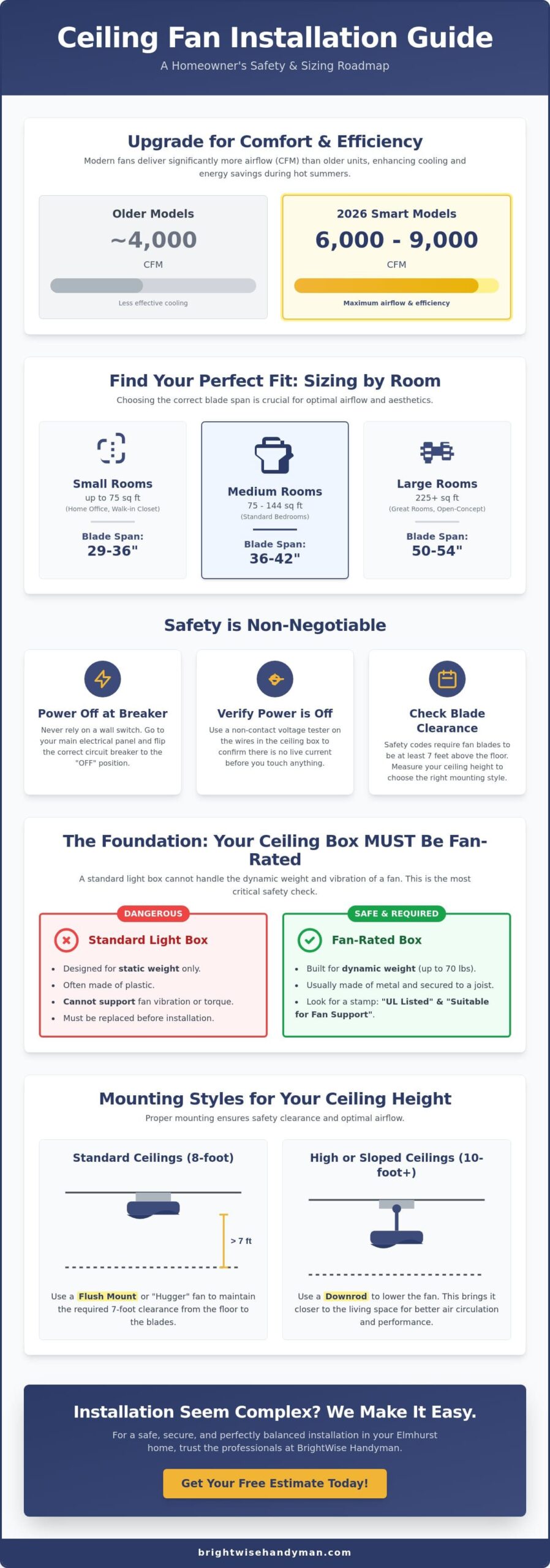
Success in any home improvement project begins long before you climb a ladder. For a proper ceiling fan installation, we must first look at the specific environment of your Elmhurst home. While many people shop based on the color of the blades or the style of the glass, we recommend looking at the Cubic Feet per Minute (CFM) rating first. In our humid Illinois summers, high airflow is what actually keeps you cool by aiding evaporation on your skin. Many 2026 smart models now produce between 6,000 and 9,000 CFM, which is a significant jump in efficiency compared to older units. We want to ensure your new fixture does more than just look good; it needs to perform when the July heat hits.
Safety is our first priority, and it starts at the breaker box. Never rely on a wall switch to cut the power, as some older wiring configurations may still have live leads at the ceiling box even when the switch is off. Go to your main electrical panel and flip the breaker. Once you are at the fixture, use a non-contact voltage tester to verify the wires are dead. While the history of the ceiling fan shows how much these machines have evolved from simple belt-driven tools to high-tech appliances, the basic principles of electrical safety remain constant. Along with your voltage tester, make sure you have wire strippers, a screwdriver set, and a sturdy A-frame ladder that allows you to work comfortably without overextending.
Calculating Your Ideal Fan Size
Choosing the right blade span is essential for both aesthetics and airflow. If a fan is too small, it won’t move enough air; if it’s too large, it can overwhelm the room. We suggest following these general guidelines for our local homes:
- Small Rooms (up to 75 sq ft): Look for a 29 to 36 inch blade span. These are perfect for walk-in closets or small home offices.
- Medium Rooms (75 to 144 sq ft): A 36 to 42 inch span provides the optimal airflow for standard bedrooms.
- Large Living Areas (225+ sq ft): For open-concept floor plans or great rooms, we recommend 50 to 54 inch fans to ensure the breeze reaches every corner.
Special Considerations for Local Homes
Elmhurst features a beautiful mix of historic architecture and modern builds, and each presents unique challenges. Many older homes in our community still have original plaster ceilings or outdated wiring systems, such as knob and tube. It is vital to identify these ungrounded systems early, as they require specific handling to meet the 2021 International Code Series adopted by the City of Elmhurst. Additionally, ceiling height dictates your mounting style. For a standard 8-foot ceiling, a flush mount or “hugger” fan is best to maintain the required 7-foot clearance between the floor and the blades. If you have 10-foot ceilings or higher, we use a downrod to bring the fan closer to the living space, ensuring the airflow isn’t lost in the rafters. We take these structural details seriously to ensure your ceiling fan installation is both beautiful and code-compliant.
The Foundation: Ensuring Your Ceiling Box is Fan-Rated
Many homeowners assume they can simply swap a light fixture for a fan without changing the hardware behind the drywall. This is a dangerous mistake. A standard light fixture box is designed to hold static weight, meaning an object that just hangs there. A ceiling fan creates dynamic weight through vibration, torque, and rotation. If your current box is plastic or feels loose, it won’t handle these forces. Most fan-rated boxes are built to support up to 70 lbs of this moving force, providing the structural integrity needed for a safe ceiling fan installation. If you are also planning a light fixture replacement elsewhere in your home, reviewing a comprehensive safety checklist beforehand will help you avoid the same mounting box mistakes across all your fixtures.
To identify if your setup is safe, take a close look inside the metal housing. You are looking for a stamped label or a permanent mark that says “UL Listed” and “Suitable for Fan Support.” If you don’t see this stamp, the box must be replaced. While a step-by-step installation guide can help you with the wiring, the structural foundation is what keeps the fan from falling. We’ve seen many DIY projects stalled by a wobbly light box, and it’s always better to address it now rather than after the fan is fully assembled.
Inspecting the Existing Junction Box
First, verify how the box is attached to your home. It should be screwed directly into a ceiling joist or supported by a heavy-duty metal brace. If the box moves when you touch it, or if the screw holes appear stripped, it’s a sign of a failing system. The 2026 National Electrical Code (NEC) now requires fan-rated boxes in living and sleeping areas for a reason. Safety standards have evolved to prevent accidents caused by metal fatigue. If the structural work feels daunting, we can help with professional ceiling fan installation to ensure your home remains safe and compliant with Elmhurst building codes.
Installing a Retrofit Fan Brace
You don’t always need attic access to fix a weak foundation. A retrofit expansion brace is designed to fit through the existing hole in your drywall. You simply insert the brace, rotate the bar, and it expands until the spiked ends bite into the wooden joists. Once it’s locked in place, you attach the new metal fan-rated box. Make sure the box sits flush with the ceiling surface. If it’s recessed too far, you’ll end up with an unsightly gap between the fan canopy and the drywall. Taking the time to get this foundation right ensures a quiet, wobble-free experience for years to come. We believe that a job done right starts with what you can’t see.
Step-by-Step: Wiring and Mounting Your Ceiling Fan
Now that your fan-rated box is secure, it’s time to begin the physical assembly. We always recommend assembling the motor, downrod, and canopy on the ground or a sturdy table before you ever step onto the ladder. This simple step saves your arms from unnecessary fatigue and ensures every screw is tightened correctly. Most modern fans include a mounting bracket with a built-in hook. This hook acts as an “extra hand,” allowing you to hang the motor safely while you focus on the wiring connections. It’s these small professional details that make a ceiling fan installation feel manageable rather than overwhelming.
We believe that taking your time during this phase ensures the long-term reliability of the fixture. When you’re working overhead, every movement should be deliberate. Having your tools organized and your parts pre-assembled means you spend less time on the ladder and more time enjoying the result. It’s about working smarter, not harder, to achieve a professional-grade finish in your home.
The Wiring Process Explained
Wiring is often where homeowners feel the most anxiety. Start by using your non-contact voltage tester one last time to confirm the circuit is dead. In a standard setup, you’ll connect the black wire from the ceiling to the black wire of the fan. The white wires pair together, and the green or bare copper wires connect to the ground screw. If your fan has a light kit, you’ll likely see a blue wire. If you have two switches on your wall, the blue wire connects to the second power wire, often red, to allow independent control of the light and the fan. If you only have one switch, the blue and black fan wires both connect to the single black house wire. Twist the copper ends together firmly and secure them with wire nuts. We make sure no bare copper is visible outside the nut before gently tucking the bundle into the junction box. Proper wire management prevents pinching when you finally slide the canopy into place.
Mounting the Motor and Canopy
Once the wiring is secure, lift the motor from the hook and guide it into its final position within the mounting bracket. Most fans use a ball-and-socket design. The seat of the ball-joint into the bracket groove is a critical alignment point that prevents the fan from wobbling during operation. Align the canopy with the bracket screws, taking care not to scratch the finish against the ceiling. We find that using a magnetic screwdriver helps keep these small screws in place while you work overhead. Tighten everything until it’s snug, but avoid over-tightening, which can warp the canopy and create unwanted noise. Your ceiling fan installation is now structurally and electrically complete, leaving only the aesthetic finishes to go.
Finishing Touches: Blades, Balancing, and Troubleshooting
Once the motor is securely mounted, we shift our focus to the blades. While this seems like the simplest part of the project, it requires a meticulous touch to ensure a quiet operation. We recommend attaching the blades to the blade irons first, then securing the irons to the motor. Use a consistent amount of torque on every screw. If one blade is tighter than the others, it can cause a slight imbalance that leads to a rhythmic clicking sound later on. We take pride in these small details because they prevent the frustration of a noisy fixture in a quiet bedroom.
Eliminating the Infamous Wobble
A wobbly fan is usually the result of uneven blade height or weight distribution. We use a simple pro trick called the “Dime Test” to identify the problem blade. Tape a dime to the top center of one blade and turn the fan on. If the wobble gets worse, move the dime to the next blade until you find the one that stabilizes the movement. You can then replace the dime with a permanent weighted clip from a balancing kit. Additionally, use a yardstick to measure the distance from the tip of each blade to the ceiling. If one blade is more than 1/8th of an inch off, you may have a bent blade iron or a warped wood blade that needs adjustment. If your fan continues to wobble after these steps, we provide expert ceiling fan installation services to get your home perfectly balanced.
Troubleshooting Common Noise Issues
Don’t be alarmed if your brand new fan makes a slight humming sound immediately after power-up. Most new motors require a 24-hour break-in period for the internal lubricants to distribute evenly. If the noise persists, check for loose light kit glass or pull chains that might be hitting the motor housing. One of the most common causes of a persistent electrical hum is the use of an incompatible dimmer switch. Most fans require a specific 3-speed wall control rather than a standard light dimmer. We always verify that the wall switch matches the motor’s requirements to ensure a silent, peaceful environment in your home.
Finally, remember to set the direction of your fan based on the season. In the summer, your blades should spin counter-clockwise to push a cooling breeze directly down. During our cold Elmhurst winters, flip the switch to clockwise at a low speed. This pulls cool air up and pushes the warm air trapped at the ceiling back down into the room. A quick dusting every few months prevents debris from building up on the leading edge of the blades, which keeps the motor running cool and efficient. Your ceiling fan installation is now complete, providing both aesthetic beauty and functional comfort for years to come.
Smart Fans and Professional Installation in Elmhurst
Modern homes are becoming more connected, and your cooling system is no exception. We’ve seen a significant shift in 2026 toward smart technology integration in our local community. Modern fans are no longer just about moving air; they are about precise, automated climate control. By choosing a model with a DC motor, you can reduce electricity usage by up to 70% compared to traditional AC motors while enjoying nearly silent operation. These technological leaps make a professional ceiling fan installation a smart investment for both your comfort and your long-term utility bills.
Upgrading to a Smart Ceiling Fan
You don’t necessarily need to buy a brand-new unit to enjoy modern features. We often install Wi-Fi enabled receivers into existing fans, allowing you to control speed and lighting from your smartphone. This integration allows you to set schedules that lower cooling costs while you are away at work. For the ultimate convenience, we sync these systems with home hubs like Google Home or Amazon Alexa. Imagine walking into your living room and simply using a voice command to activate a cooling breeze. When synced with a smart thermostat, your fan can even trigger automatically when the room reaches a specific temperature, ensuring your Elmhurst home stays perfectly tempered without you lifting a finger.
Why Professional Installation Makes Sense
While many homeowners feel confident with basic tasks, certain scenarios demand the expertise of a seasoned professional. High-ceiling foyers or installations over staircases present significant safety risks that standard A-frame ladders cannot safely accommodate. We possess the specialized equipment and experience to handle these challenging heights with ease. Additionally, older homes in our Elmhurst community often feature brittle or confusing wiring that requires a careful, expert hand to prevent shorts or fire hazards. We take the guesswork out of the process, ensuring your home remains a safe sanctuary for your family.
We believe in providing more than just a service; we offer a partnership in home stewardship. Every project we touch is treated with the same respect we give our own properties. We ensure your installation is fully code-compliant with the 2021 International Code Series adopted by the city. We leave your home as clean as we found it and provide a steady, no-wobble finish that stands the test of time. Ready for a breeze? Book your professional ceiling fan installation with BrightWise Handyman today! We are here to help you upgrade your home with quiet confidence and integrity.
Enjoy a Cooler, More Efficient Home Today
We believe that a successful home upgrade should bring you lasting comfort and absolute peace of mind. By following this guide, you now understand the critical importance of a fan-rated junction box and the precision required for safe electrical wiring. Whether you are installing a high-airflow DC motor or integrating a new smart fan into your home hub, these steps ensure your fixture is both beautiful and secure. A proper ceiling fan installation adds functional value to your property while helping you manage those humid Illinois summers with ease.
We understand that your time is valuable. Some projects, especially those involving high ceilings or complex wiring in historic properties, require a professional touch. We are proud to serve Elmhurst and the Western Suburbs with quiet confidence and integrity. Our team focuses on expert smart home integration while maintaining a disciplined approach to safety. We are fully insured and committed to a meticulous clean-up, treating your property with the same respect we give our own.
If you’re ready to upgrade your living space without the stress of a DIY project, we are here as your dependable neighbor. Schedule Your Professional Ceiling Fan Installation with our team today. Let’s work together to make your home a more comfortable, well-lit place for your family to enjoy.
Frequently Asked Questions
How much does it cost to have a ceiling fan professionally installed in Elmhurst?
Professional installation costs depend on whether you are replacing an existing fixture or running new wiring to a fresh location. While national averages for labor often range between $145 and $356, local factors like the City of Elmhurst residential electrical permit fee of $127.00 for new wiring projects can influence the total. We recommend checking with a professional to see if your specific project requires a permit through the city’s online portal.
Can I install a ceiling fan where there isn’t currently a light fixture?
Yes, you can install a fan in a new location, but this requires running new electrical cables through your ceiling and walls. This process is more complex than a simple swap because it involves cutting into drywall and installing a fan-rated brace between the joists. For a safe ceiling fan installation in a new spot, you must ensure the new wiring meets the 2021 International Code Series standards adopted by Elmhurst.
Is it safe to install a ceiling fan myself if I’ve never done electrical work?
How do I know if my ceiling box is strong enough for a fan?
You can identify a safe junction box by looking for a “UL Listed” stamp that specifically says “Suitable for Fan Support” inside the metal housing. Standard plastic or metal light boxes aren’t designed to handle the dynamic weight and vibration of a spinning motor. If you don’t see this label, you must replace the box with a fan-rated version to prevent the fixture from eventually loosening or falling.
What is the best height for a ceiling fan in a standard room?
The National Electrical Code requires that fan blades be at least 7 feet above the floor for safety. For the most comfortable airflow in a room with 8 or 9-foot ceilings, we find that a height of 8 feet is the “sweet spot.” If your ceilings are higher, using a downrod will help bring the blades closer to the living area, ensuring the cooling breeze actually reaches you rather than staying trapped near the ceiling.
Why does my ceiling fan make a clicking or humming noise?
Noises are usually caused by loose screws in the blades, a poorly balanced motor, or an incompatible wall switch. If you hear a persistent electrical hum, check if your fan is connected to a standard light dimmer switch. Fans require specific speed controls to prevent motor damage and noise. For mechanical clicking, we recommend tightening the blade screws and checking that the canopy isn’t rubbing against the ceiling surface.
Do I need a special switch for a ceiling fan with a light?
You don’t strictly need a special switch, but using a dual-control wall switch allows you to operate the fan and the light independently. This setup is much more convenient than relying on pull chains. If you are planning a new ceiling fan installation, we can help you set up a smart wall control. This allows you to adjust speeds and dim the lights via your smartphone or voice commands for a truly modern experience.
Can a ceiling fan really lower my AC bill in a Chicago summer?
A ceiling fan can lower your energy costs by allowing you to raise your thermostat by about 4 degrees without losing comfort. This works because of the wind-chill effect, which makes the air feel cooler on your skin. While the fan doesn’t actually lower the room temperature, it allows your AC to run less frequently. Using energy-efficient DC motors can further reduce electricity usage by up to 70% compared to older models.
