
Why does a perfectly smooth drywall patch often look like a glowing “halo” the moment you apply the topcoat? Most homeowners in our community have felt that pang of frustration when a structural fix remains visible because of a texture mismatch or paint flashing. We understand that you don’t just want a hole filled; you want your wall to look like the damage never happened in the first place. When it comes to painting after drywall repair Elmhurst residents often find that the transition from sanding to the final brushstroke is where the real challenge lies.
The “Invisible Repair” isn’t just about picking the right color. It’s about the technical bridge between the joint compound and the topcoat. We’ll show you the exact process for making repairs disappear using professional techniques tailored for our local homes. You will discover how to handle dust during the transition, when to paint the whole wall versus just the patch, and how to find a local partner who values your property’s integrity as much as you do. We’re here to help you turn a stressful repair into a seamless, brand new finish.
Key Takeaways
- Learn why standard touch-ups often lead to “ghosting” and how to prevent settling cracks from reappearing months later.
- Master the two-step preparation process involving progressive sanding and chemical cleaning to ensure perfect paint adhesion.
- Understand the realities of UV fade and how to achieve professional painting after drywall repair Elmhurst homes require for a perfect texture match.
- Discover the “Natural Break” strategy to help you decide when to paint a single patch or refresh the entire wall.
- See how an integrated approach to repair and finishing keeps your home clean and eliminates the evidence of structural work.
Why Painting After Drywall Repair in Elmhurst is More Than a “Touch Up”
Many homeowners assume that once a hole is filled and sanded, the hard part is over. However, a common phenomenon known as “ghosting” often proves otherwise. This occurs when a patch looks perfect initially but begins to reappear as a dull or shiny spot months after the work is finished. In our local area, this is frequently compounded by the natural settling of homes. The Chicago western suburbs sit on soil that shifts with the seasons, leading to recurring hairline cracks that require more than just a quick dab of paint. When performing painting after drywall repair Elmhurst residents need a strategy that accounts for how materials age and move over time.
Fresh joint compound is significantly more porous than the surrounding aged drywall. Without the right preparation, the new surface sucks the moisture out of the paint differently than the rest of the wall. This creates a texture and sheen mismatch that is impossible to ignore. By understanding drywall and its cellular structure, we can better appreciate why a high-quality primer is mandatory to seal that “thirsty” new patch. Elmhurst homes often feature large suburban windows that let in plenty of natural light. While beautiful, this side-lighting acts like a spotlight on poor repair work, highlighting every minor ridge or sanding mark that a simple touch-up failed to hide.
The Challenge of Older Elmhurst Interiors
Many properties in our neighborhood, especially those built before 1960, aren’t just standard drywall. They often feature plaster-drywall hybrids or thick lath and plaster. These materials react differently to the extreme temperature fluctuations we see in Illinois. When the heat kicks on in November, the house contracts. In the humid July heat, it expands. If a repair isn’t “feathered” out correctly across a wide area, these shifts create a visible hump on the wall. We focus on structural stability to ensure the repair remains flush and stable through every season.
The Aesthetic Standard: Why Near-Perfect Isn’t Enough
A visible patch in a high-traffic area like a kitchen or living room can be a constant source of irritation. It draws the eye. It makes a well-maintained home feel neglected. Professional painting after drywall repair Elmhurst isn’t just about vanity; it’s about preserving your home’s resale value. In a competitive real estate market, buyers look for signs of quality stewardship, a standard upheld by residential firms like precisioninnovative.com during major home renovations. At BrightWise Handyman, we aim for an “Invisible Finish.” This means that under any lighting condition, there is no evidence that a repair ever took place. We treat your property with the same care we would give our own, ensuring the final result is a seamless addition to your home’s aesthetic.
The Critical Bridge: Preparing the Surface for a Seamless Finish
A flawless wall starts long before the paint can is opened. The transition from a structural repair to an aesthetic finish is where most DIY projects fail. We believe the secret to professional painting after drywall repair Elmhurst homeowners can be proud of lies in the discipline of the preparation phase. If the surface isn’t perfectly level and chemically clean, the paint will highlight every flaw rather than hiding it. We treat this stage as a bridge that connects the rough work of the repair to the refined beauty of the final coat.
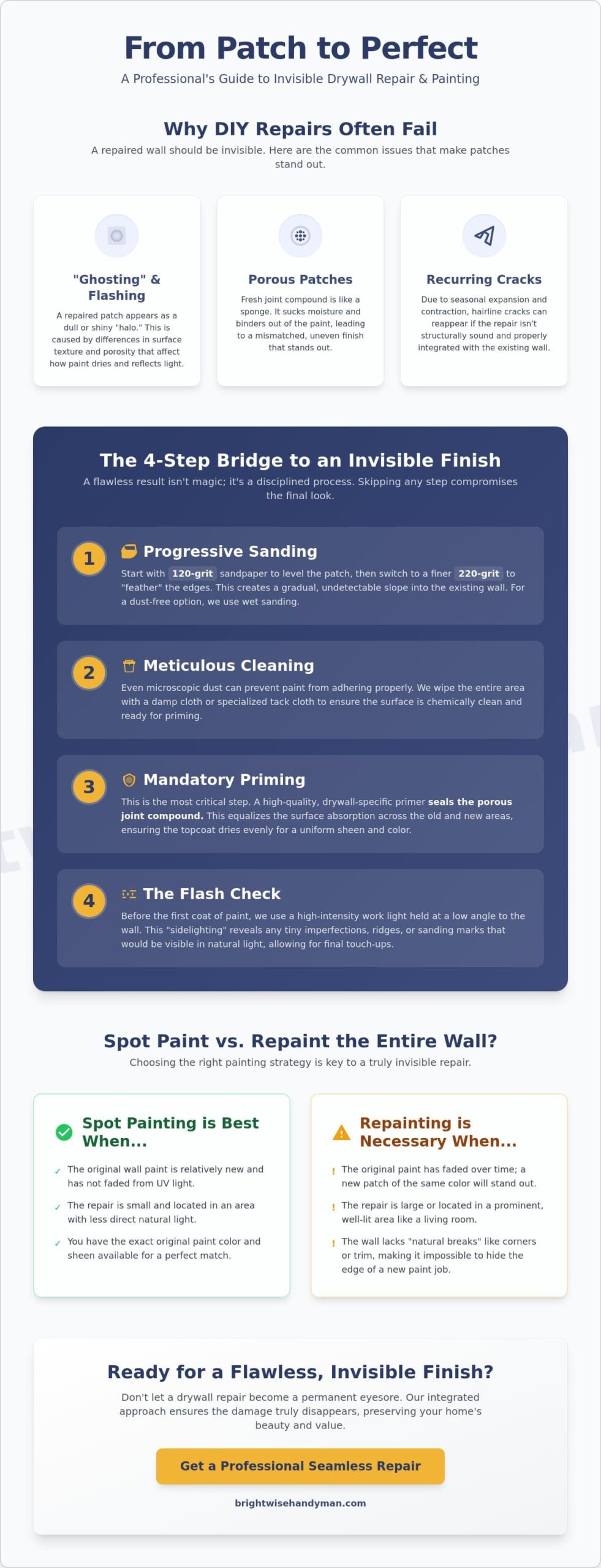
- Step 1: Progressive Sanding. We use a multi-stage approach to ensure the patch blends into the original wall.
- Step 2: Chemical Cleaning. Removing micro-dust is essential for paint adhesion.
- Step 3: Sealing. We apply specialized primers to manage the high porosity of joint compound.
- Step 4: The Flash Check. We use high-intensity side-lighting to identify “flashing” or ridges before the first coat of color.
Sanding Techniques for a Disappearing Edge
We begin by using 120-grit sandpaper to knock down high spots. Once the area is level, we transition to a finer 220-grit paper to polish the edges. This “feathering” technique involves expanding the sanding area several inches beyond the patch itself. By thinning the compound at the perimeter, we create a slope so gradual that the human eye cannot detect where the repair ends. For occupied homes in Elmhurst, we often utilize wet sanding. This method uses a specialized damp sponge to smooth the compound, which eliminates the cloud of white dust typically associated with drywall work and keeps your living space pristine.
Priming: The Unsung Hero of Drywall Repair
Joint compound is incredibly “thirsty.” If you apply paint directly to it, the compound drinks the moisture, leaving the paint pigment sitting on the surface without a proper bond. This results in a flat, dull spot known as flashing. We believe that meticulous priming is the most critical step for successful painting after drywall repair Elmhurst projects, as it creates a uniform canvas for the final color. We use high-build primers for larger repairs to help fill in any remaining microscopic textures. For Elmhurst dining rooms featuring deep, dark tones, we often tint the primer to match the final color. This ensures rich color depth and prevents the white patch from peeking through the topcoat. If you’re feeling overwhelmed by the technical details of surface prep, our team can handle the entire drywall repair and painting process for you, ensuring a result that looks brand new.
Before we ever dip a brush into the final paint, we perform a “Flash Check.” By holding a bright light parallel to the wall, we cast long shadows over any imperfections. This allows us to fix tiny ridges or pinholes while they are still in the primer stage. This extra step guarantees that your wall will look smooth from every angle, even when the afternoon sun hits it directly.
Color Matching and Texture Blending for Elmhurst Homes
Sheen also plays a massive role in how a repair looks under the bright lights of a suburban home. Flat paint is forgiving, but most Elmhurst kitchens and bathrooms use Eggshell or Satin for durability. These higher sheens are notorious for “flashing” if the texture underneath isn’t identical to the rest of the wall. If the patch is smoother or rougher than the surrounding area, the light will reflect off it at a different angle. This makes the repair visible even if the color is a 100% match. We focus on matching the light reflectivity just as much as the pigment.
Achieving a Perfect Color Match
We always recommend taking a physical sample, about the size of a silver dollar, to the local Elmhurst Sherwin-Williams. Their specialists can use a spectrophotometer to match the current, faded state of your wall rather than the original factory color. This helps combat “metamerism,” a phenomenon where colors look identical under store lights but clash under your home’s LED or incandescent bulbs at night. We also use a technique called “feathering” with a dry brush to soften the transition between the new paint and the existing wall.
Mastering the Wall Texture
Matching the texture is just as vital as the color. Whether your home features a light “Orange Peel” or a heavy “Knockdown” finish, the goal is to replicate the original applicator’s technique. We use everything from professional hopper guns for large areas to specialized aerosol sprays for small patches. For the unique character of older Elmhurst homes, we often resort to hand-troweled textures to mimic vintage plaster work. Always test your texture on a scrap piece of cardboard first to calibrate your spray pattern and pressure before touching the actual wall.
To truly guarantee a seamless look, we often follow the “Corner-to-Corner” rule. Instead of stopping at the edge of the patch, we apply a fresh coat to the entire wall from one natural break to the next. This ensures that any microscopic differences in color or sheen are hidden by the corners of the room. It’s the most reliable way to achieve professional painting after drywall repair Elmhurst residents expect, leaving you with a wall that looks completely untouched by previous damage.
Spot Painting vs. Painting the Whole Wall: Making the Right Call
One of the most frequent questions we hear from homeowners is whether they can simply paint the patch or if the entire wall needs a fresh coat. Deciding on the scope of painting after drywall repair Elmhurst projects depends on several technical factors. While spot painting saves time, it can quickly become a recipe for disaster if the conditions aren’t perfect. We always look for “Natural Breaks” in the room’s architecture to guide this decision. A corner, a door frame, or a piece of crown molding acts as a visual reset for the eye. By ending your new paint at these points, you hide the slight variations in color or sheen that would be obvious in the middle of a flat surface.
The light sources in your home play a significant role here. If the repair is on a wall directly opposite a large window, the side-lighting will expose even the slightest mismatch. In these high-visibility areas, we almost always recommend painting the entire wall to ensure a seamless finish. It’s about more than just color; it’s about how the light interacts with the surface. A full wall of fresh paint ensures that the reflectivity is uniform from one corner to the other.
The Spot Painting Checklist
We use a specific set of criteria to determine if a spot repair will be successful. First, consider the age of your existing paint. If it was applied less than two years ago, the chances of a successful match are high. Beyond that timeframe, environmental factors have likely caused enough fading to make a patch stand out. Second, check the sheen level. Flat paint is incredibly forgiving because it doesn’t reflect much light. However, if you’re dealing with Eggshell or Satin, spot painting often leads to “sheen flashing,” where the patch appears shinier than the rest of the wall. Finally, look at the location. A repair inside a dimly lit hallway or behind a piece of furniture is a great candidate for a quick touch-up.
Why Full-Wall Painting is Often the Better Value
In many cases, painting the whole wall provides a far superior return on your investment. It completely eliminates the risk of visible transitions. Since you’ve already moved the furniture and laid down drop cloths for the drywall repair, the incremental effort to roll the entire wall is minimal. This is an excellent opportunity to refresh the room’s aesthetic and ensure long-term durability. Our professional interior painting services are designed to handle these transitions with precision. We believe in doing the job right the first time so you can enjoy your home without constantly noticing a “fixed” spot. If you want to ensure your walls look brand new with no evidence of repair, we encourage you to book an estimate with our team to discuss your project scope.
Professional Results with BrightWise Handyman’s Integrated Service
Choosing a single partner to handle both the structural fix and the aesthetic finish is the most reliable way to ensure a seamless result. When you hire separate teams for painting after drywall repair Elmhurst, details often get lost in the handoff. A painter might blame a poor finish on the drywaller’s sanding, while the drywaller assumes the paint will hide any minor ridges. We eliminate this friction by providing a single point of accountability. We take pride in our work from the first piece of tape to the final brushstroke, ensuring that every layer of the project meets our high standards for an “Invisible Finish.”
Our “Handyman First” approach gives us a distinct advantage. We understand the underlying mechanics of your home’s walls. Whether we’re performing a small patch or a comprehensive drywall repair, we prepare the surface with the final coat of paint in mind. Because we’re the ones responsible for the color match and sheen consistency, we’re naturally more meticulous during the sanding and priming phases. We don’t just fill holes; we restore the integrity of your living space.
Cleanliness is a cornerstone of our service. We know that drywall work is notoriously messy, which is why we’ve developed our “Clean-Site” promise. We use active dust containment strategies, including HEPA vacuum attachments and protective floor coverings, to keep your Elmhurst home pristine. Our team respects your property as if it were our own. We believe that a professional job isn’t finished until your room is as clean as the day we arrived, with nothing left behind but a perfect wall.
The BrightWise Advantage
We focus on the small details that larger crews often overlook. From ensuring your outlet covers are perfectly centered to checking the sheen of your trim, our meticulous nature defines our brand. We provide transparent pricing and reliable scheduling because we value the time of our fellow Elmhurst families. You won’t have to wonder when we’ll show up or if the price will change mid-project. We’re your neighbors, and we’re committed to building long-term trust through consistent, high-quality craftsmanship.
Your Next Steps to a Perfect Wall
Getting started is simple. We offer a straightforward estimation process that respects your schedule. Before we arrive, we ask that you move small breakables and clear the immediate work area. We’ll handle the heavy lifting, including moving larger furniture and providing all necessary drop cloths. Our goal is to make the transition from a damaged wall to a brand new finish as stress-free as possible. Don’t let a visible repair distract from the beauty of your home any longer. Book your Elmhurst drywall repair and painting service today and experience the peace of mind that comes with a truly professional finish.
Restore Your Home’s Beauty with Confidence
Achieving an invisible finish doesn’t have to be a source of stress for your family. We have explored how meticulous surface preparation, accurate color matching, and the right decision between spot painting and full-wall coverage create the seamless results you deserve. By focusing on the technical bridge between joint compound and the final topcoat, you can ensure your walls look brand new under any lighting. When you choose an all-in-one solution for painting after drywall repair Elmhurst, you gain the peace of mind that comes with a single point of accountability from start to finish.
Our team at BrightWise Handyman brings local Elmhurst-based expertise to every project. We are 5-star rated for our cleanliness and reliability, and we always treat your property with the same care we give our own homes. We believe in providing a service that adds both functional and aesthetic value to your stewardship of your property. If you are ready to make your drywall repairs disappear and refresh your interior spaces, we are here to partner with you.
Get a Professional Estimate for Your Painting and Drywall Project
We look forward to helping you restore the beauty and integrity of your home with our disciplined, professional approach.
Frequently Asked Questions
How long should I wait for drywall mud to dry before painting?
You should wait at least 24 hours for standard joint compound to dry completely. Thicker patches or high humidity in our local area can extend this time to 48 hours. If the patch feels cool to the touch or looks slightly gray, it’s still holding moisture. Painting too early traps that moisture, which eventually leads to the paint peeling or bubbling off the wall.
Can I skip primer if I use a “Paint + Primer” in one product?
No, we don’t recommend skipping a dedicated primer for new drywall patches. Paint + Primer products work well for previously painted surfaces, but they aren’t designed for raw, porous joint compound. A specialized PVA primer seals the surface effectively. This prevents the compound from absorbing the paint unevenly, which is the most common cause of dull spots on a finished wall.
Why does my drywall patch look darker than the rest of the wall?
This darkening is usually caused by “flashing,” where the patch absorbs more paint pigment than the surrounding wall. Even if the color is a match, the difference in porosity changes how light reflects off the surface. Proper priming and applying two full topcoats help ensure that painting after drywall repair Elmhurst projects result in a uniform color and sheen across the entire surface.
How many coats of paint are needed after a drywall repair?
You should apply one coat of primer followed by two full coats of topcoat paint. The first topcoat provides the initial color, while the second coat ensures even sheen and long-term durability. Skipping the second coat often leaves the repair visible under bright natural light. We find that three total layers are necessary to achieve a truly professional, “invisible” result.
What is the best paint sheen for hiding drywall imperfections?
Flat or matte finishes are the best for hiding imperfections because they absorb light rather than reflecting it. Higher sheens like semi-gloss or satin act as a spotlight for every minor bump or ridge in the drywall. If you need durability in a high-traffic Elmhurst hallway, an eggshell finish offers a good balance between washability and the ability to mask minor surface flaws.
Should I sand between coats of paint on a new drywall patch?
Yes, a light scuff sanding with 220-grit sandpaper between coats creates a much smoother final finish. This process removes tiny dust nibs or raised wood fibers from the drywall paper that the moisture in the paint might have pulled up. Always wipe the wall with a clean tack cloth after sanding to ensure the next coat of paint adheres perfectly to the surface.
Can a handyman handle both the repair and the painting in Elmhurst?
Yes, a professional handyman is often the ideal choice for painting after drywall repair Elmhurst services. We handle the structural patching, texture matching, and final painting as a single, organized project. This integrated approach ensures a seamless transition between the repair and the finish, providing you with a single point of accountability and a cleaner, faster result for your home.
How do I match the texture of my existing wall to the new patch?
Match the texture by practicing your technique on a scrap piece of cardboard before touching the actual wall. If your wall has a light “orange peel” look, use a small-diameter, high-nap roller to apply the compound. For heavier textures like knockdown, you may need a specialized sponge or a texture spray. Adjust your pressure and pattern density until it blends perfectly with the surrounding area.
